
Blog
How to engage children in story time

Guest blog – How to engage children in story time by Susan Cooper
Sharing stories with children of all ages is really important. Not only can it inspire them to develop a love of reading and the curiosity to seek out their own reading choices, it can also help children to develop their vocabulary and language skills and spark imagination in their writing.
For the story teller, sharing stories with children can be so much fun too! It’s a wonderful feeling to look around and see that the children are gripped by the story; they are focused on every word you read; they wait expectantly for the story to continue; they gasp with excitement; they laugh out loud at the funny bits and they want to keep talking about it when the story is finished!
So, how can we make sure our listeners are engaged in this way and make story time a positive experience for everyone?
Setting the scene
To begin with, having a designated story time makes it a special time during the day when everyone knows there will be a story to be heard. Perhaps children will be sitting in the reading area or library, on chairs, cushions or on the carpet.
For the story teller, the choice of story is key. Making the right choice for the listeners will determine how engaged they will be.
Consider the age of the listeners and their language skills- while you want them to hear new and enriching vocabulary, you also want them to understand and be engaged with the story.
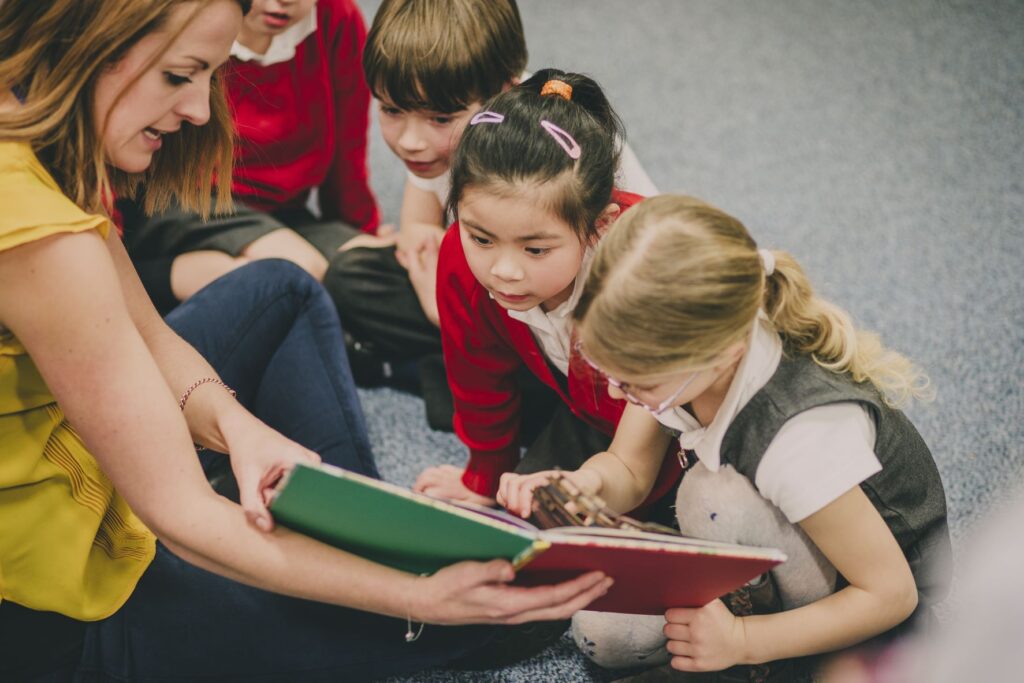
Knowing the interests of the listeners and how they will respond to humour, an element of fear or danger or a relevant social or moral theme is important.
Think about how the listeners will respond to events and characters in the story and consider its length, and how effective it might be to read the complete story or end at a key moment, leaving the listeners eager for the next instalment.
Of course, you also want the listeners to experience different settings and environments, faraway places and imaginary worlds outside of their own experience.
Presenting the story
Keep it fresh and fun! When reading the story, it is important to make effective use of your voice.
Varying your pace, rhythm, tone and volume will enhance the experience for the listeners and help to present different emotions such as excitement, suspense, humour or danger.
Think about how you will voice different characters so that the children can relate to them in different ways and make meaning from characters’ behaviour and actions. The story teller can also use gestures, sounds and actions at key points in the story to show how characters behave and interact.
If the story contains unfamiliar vocabulary, using mime and gesture can help to clarify meaning. Facial expressions can also be used to show the emotions of the characters.
The storyteller can move around as the story is told, coming closer to the audience at key moments. Props such as pictures, objects and costumes can help the audience create meaning and engagement. A story teller in costume and playing the part of one of the characters will grab attention immediately!
I once read ‘The Gruffalo’ during a World Book Day story time and was helped by other adults playing the parts of the different animals in the story- all dressed in suitable costume.
The children loved it, especially when their headteacher appeared dressed as the Gruffalo! Similarly, dressing as Mr Stink when reading David Walliams’ book also kept my listeners engaged and led to great enthusiasm for reading other stories by this author.
Audience participation and interaction
Of course, children love to be involved in the story telling process themselves and by being active participants, they will remain engaged with the story and will remember it for a long time afterwards.
Encouraging children to choose a story, to hold the book or turn the pages can be very effective. Any story can be made interactive by using accompanying sounds, actions or a recurring phrase or rhyme for the listeners to repeat.
Sometimes, it may be useful to ask children to read the speech of particular characters, using different voices.
At points in the story, the teller can pause the story to ask listeners to reflect on what has happened so far; to give their opinions on actions and to predict what might happen next, whilst making sure the ‘flow’ of the story is not interrupted.
Here, the story teller’s use of effective open-ended questions can help to check understanding and engagement with the characters and plot.
Summary
To sum up, engaging children in story time in fun and entertaining ways, can be a rewarding and productive experience for all involved.
Careful choice of text, imaginative and varied ways of presenting the story, creating an environment which allows the listeners to become immersed in the story are all important ingredients for a successful and enjoyable experience.
As well as promoting the skills of reading, writing, and listening, the test of a really good story time is when listeners always remember a story brought to life because of the way it was told.
In the words of Sir Michael Morpurgo…
“Make this the half hour that they all long for, that they don’t want to be over.
Let the children go home dreaming of the story, reliving it, wondering.”

About Susan
Susan began her career as an English and Drama teacher, working in two secondary schools in Staffordshire for seven happy years. Once her four children were all at school, she wanted a different challenge and so she decided to go into primary teaching.
She stayed there for the next twenty years, taking on the role of Special Educational Needs Coordinator and then English Leader.
Back to blog page.